Backlink gap analysis: how to get a number you can defend
A backlink gap analysis answers one question: how many good links are your competitors ahead of you? Most gap reports answer a different one: how many links do your competitors have? The difference between the two can be more than half the number.
This guide walks through seven steps, using one real, anonymised case throughout: a new site with zero backlinks and seven competitors. In that case the gap to the middle competitor was 546 referring domains before cleaning and 217 after. Site names are invented; the numbers are real.
You can do every step with a backlink export and a spreadsheet. Where linkgap automates a step, it says so.
What a backlink gap is, and the two things people mix up
"Backlink gap" is used for two different outputs:
- The gap as a number. How many good referring domains you are behind a benchmark. This is what goes into a proposal or a budget.
- The gap as a list. The domains that link to your competitors but not to you. This is what you work through afterwards.
You need both, in that order. The number tells you how big the job is. The list tells you where to start. This guide covers the number in steps 1 to 6 and the list in step 7.
Step 1: Pick competitors you actually compete with
Choose five to seven sites that rank for the searches you care about. Leave out giant brands that rank for everything, and leave out sites you admire but never meet in the results.
Seven is a practical number. With fewer than five, a single odd profile distorts the picture. With more than seven or eight, you spend most of your time on sites that don't change the answer.
Step 2: Count referring domains, not links
Ten links from one website are one vote, not ten. Export referring domains for your site and for each competitor. Every later step works on that unit.
Step 3: Rate each referring domain
A raw count treats a respected trade publication and a scraped directory the same. Sort every referring domain into good, weak or spam with rules you could explain to a client:
- very low authority
- a high spam score
- a domain ending that is common among spam sites
- an unusually high number of outbound links
- spammy anchor text
- links that are broken
Use points per rule and a threshold, so that one weak signal doesn't condemn a site and three together do. Write the rules down. When a client asks why a domain was left out, "the tool said so" is not an answer; "very low authority and a spam score above the threshold" is.
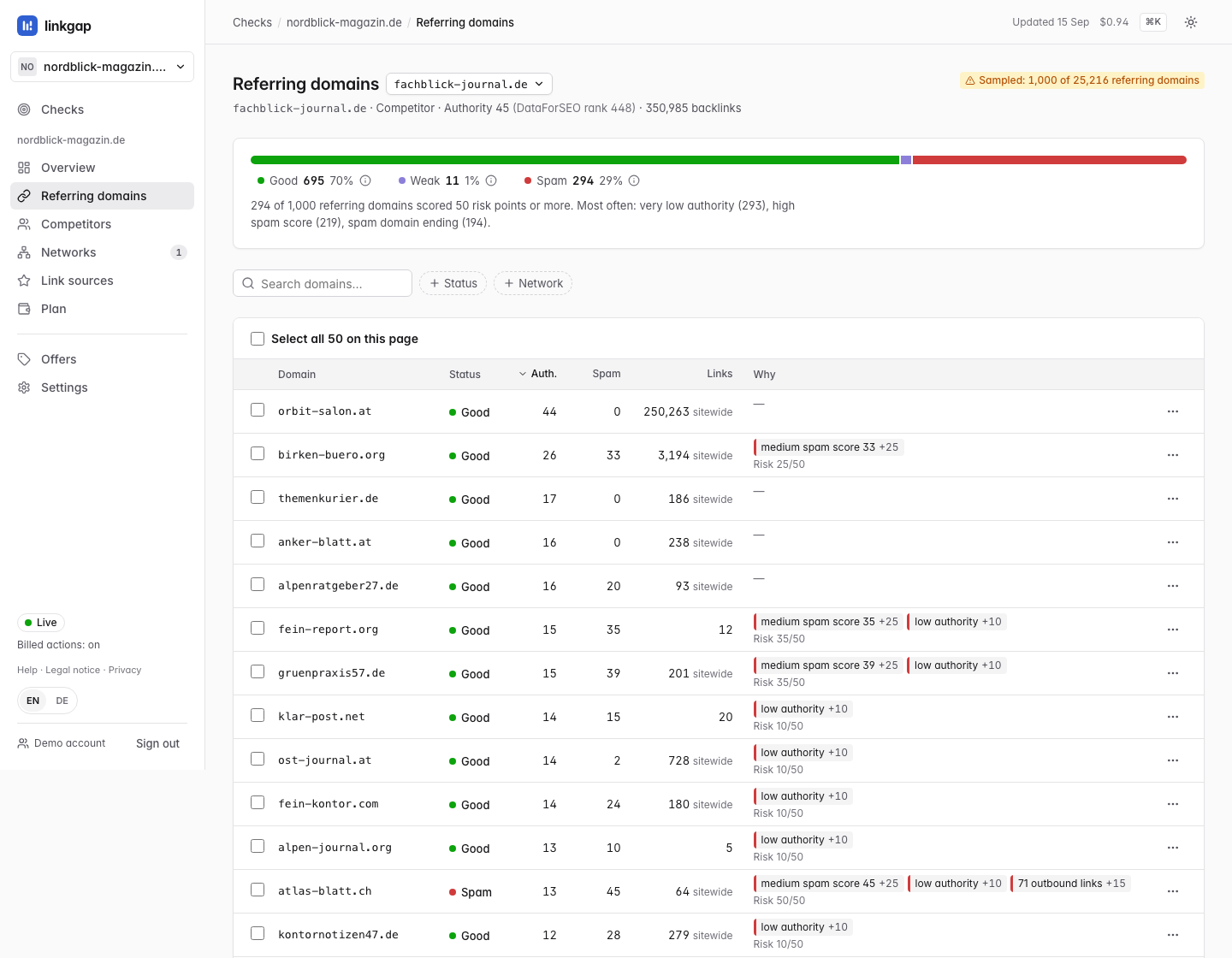
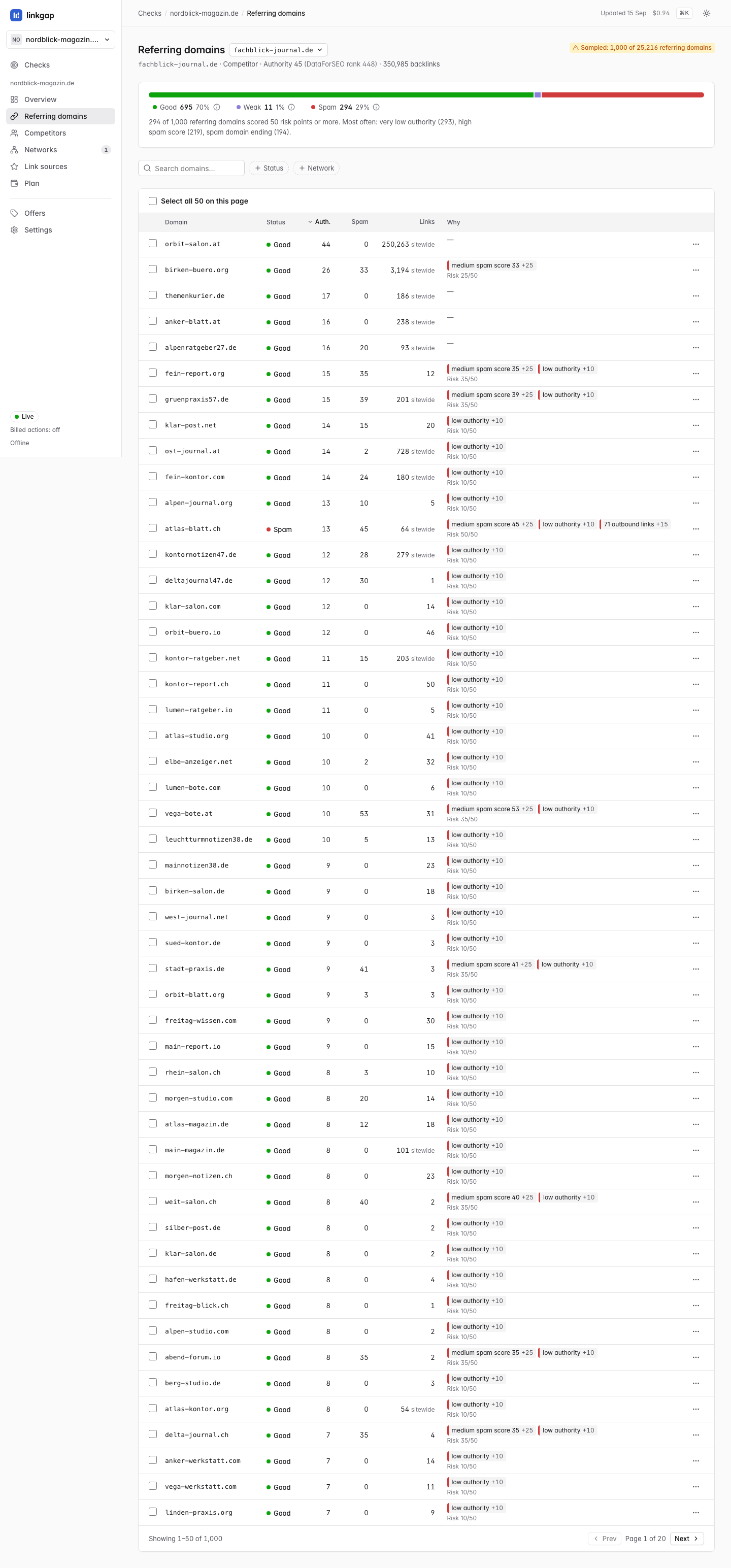
How much does this remove? In the case, the leading competitor had 25,216 referring domains. A sample of 1,000 was fetched and rated. 294 were spam, almost a third. The most common reasons were very low authority (293 domains), a high spam score (219) and a spam-typical domain ending (194).
Step 4: Sample large profiles, and say that you did
You don't need all 25,216 rows to learn what a profile is made of. A sample of 1,000 is enough to estimate the split between good, weak and spam.
Two rules keep this honest. Label every figure that comes from a sample as an estimate. And never mix sampled and fully counted profiles in one chart without marking which is which.
Step 5: Look for link networks shared by several competitors
This is the step most gap analyses skip, and in this case it changed the result more than any other.
Rating domains one at a time misses groups. A domain in a link network can look acceptable on its own. The pattern only shows when you compare who links to whom across all competitors.
In the case, 364 domains formed one group. These were the signs:
- An exclusive footprint. Every one of the 364 linked to at least two of the same three competitors, and to no other analysed site.
- Repeated authority values. 83 domains had one identical authority value, 50 shared a second and 25 a third. Independent sites rarely land on exactly the same score in such numbers.
- Very low authority. The median was 2 out of 100.
- Unrelated topics. Only 46 of the 364 domain names shared even one word with the competitors' names.
- Empty or brand-only anchors. 65% of the links had no anchor text, or just the name of the site they pointed to.
No single sign proves anything. Together they describe a link package that was bought, or injected by someone else. Google most likely ignores links like these, so they shouldn't set your target.
To check this by hand: build a table of referring domains against competitors, filter for domains that link to two or more of the same few competitors and to nobody else, then sort that subset by authority and look for repeats. Each of the five signs, with the spreadsheet check for it, is in How to spot a link network in a competitor's backlinks.
Removing the group changed the three affected competitors like this:
| Competitor (invented names) | Good referring domains before | After |
|---|---|---|
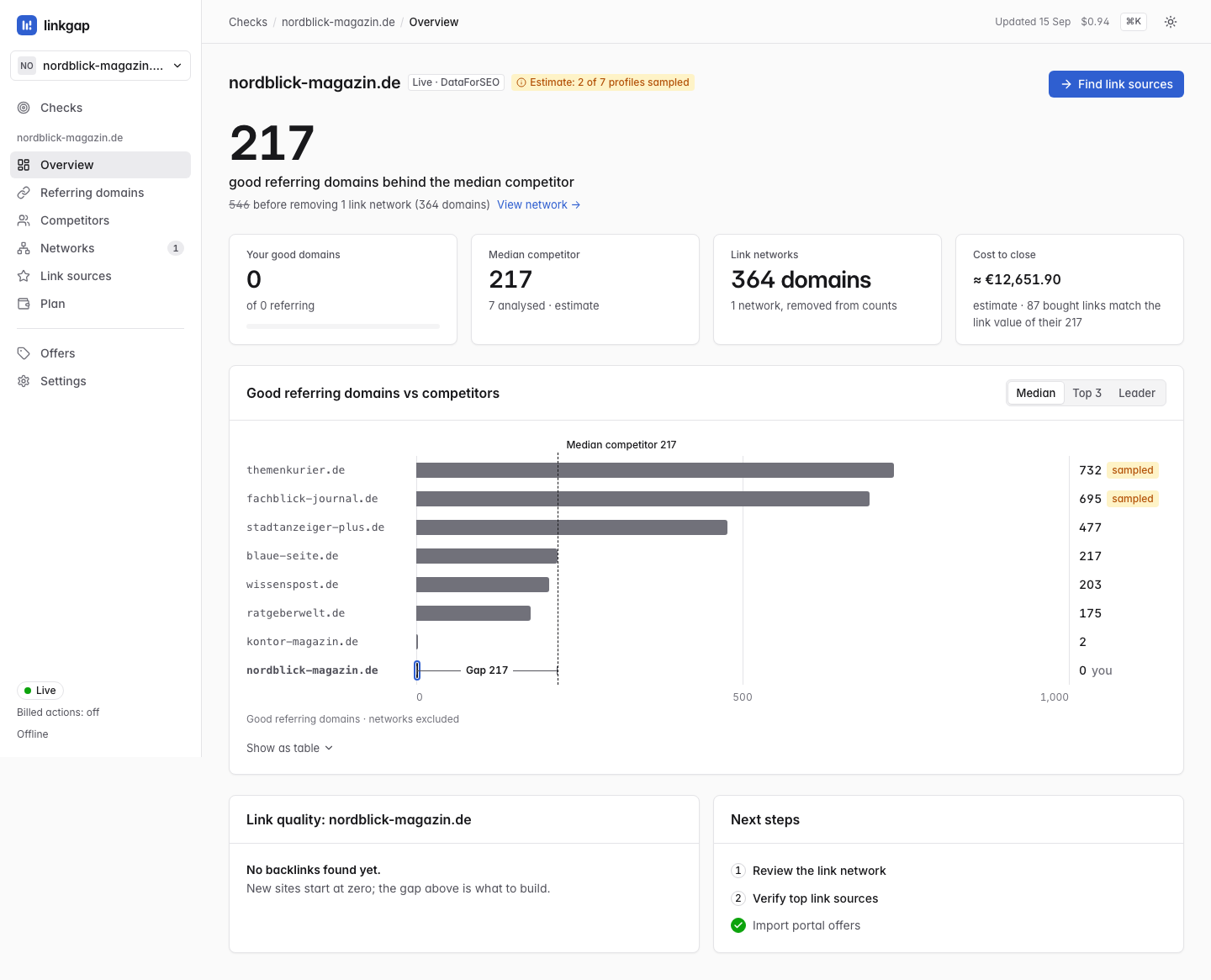
| wissenspost.de | 546 | 203 |
| blaufeder-journal.de | 491 | 217 |
| stadtanzeiger-plus.de | 635 | 477 |
Treat the result as a pattern, not a verdict. If you know a flagged group is legitimate, for example a real publisher network in that industry, put it back in.
Step 6: Measure against the middle competitor
Which competitor is the benchmark? Three options:
- The leader. Usually demoralising and rarely necessary to match.
- The average of the top three. Reasonable when you aim for the top of the page.
- The median. The competitor in the middle when you line them up. One giant or one tiny site doesn't move it.
For a first target, use the median. In the case, the median competitor had 546 good referring domains before the network was removed and 217 after. The new site had 0. The honest gap was 217, about 60% smaller than the first reading.
That one number is the difference between a budget a client approves and one they don't.
Step 7: Turn the gap into a short list
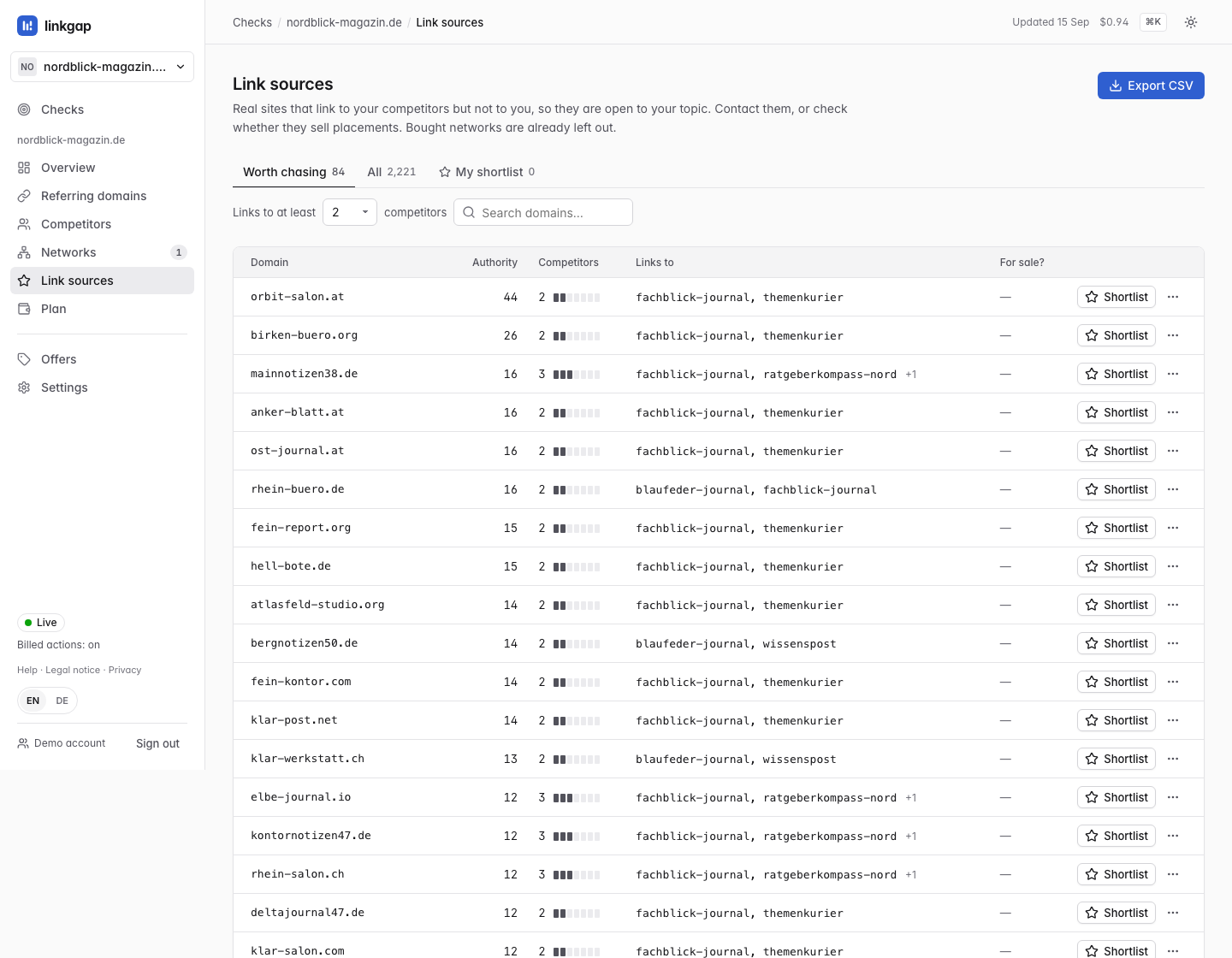
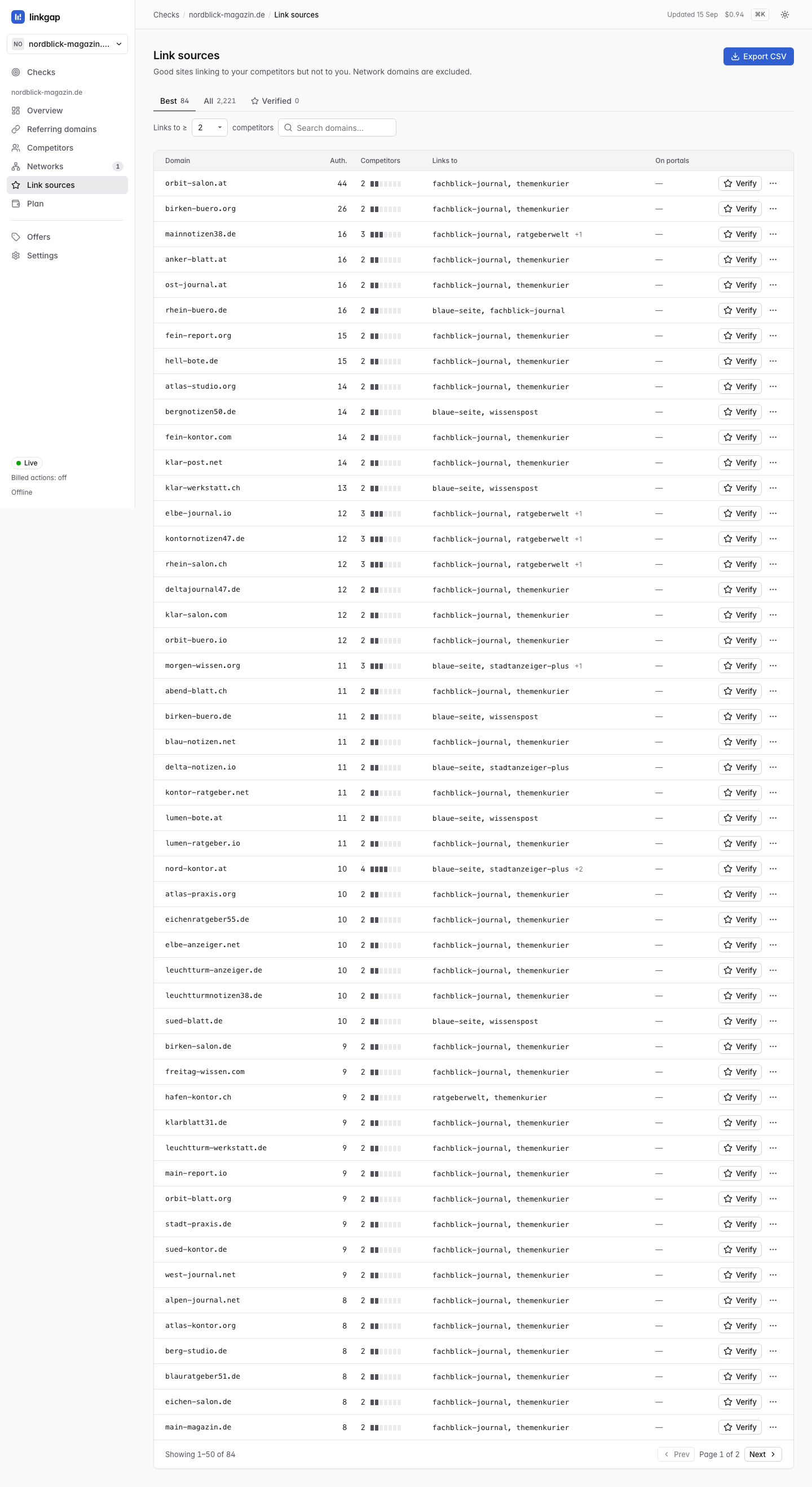
Now the list. Collect every domain that links to your competitors and not to you. In the case that was 2,221 link sources. Nobody works through 2,221 domains, so filter:
- It links to at least two competitors.
- It was rated good in step 3.
- It isn't part of a network from step 5.
- It doesn't link to you yet.
84 domains passed. That is a list a person can read in an afternoon, and it's where outreach, guest contributions or placement requests begin.
From gap to budget
A gap of 217 domains doesn't mean 217 links. The domains behind that number were weak, with a median authority of 1 out of 100. Placements available on a marketplace averaged DR 49.7. Weighing links by authority, one such placement was worth about 2.7 of the weak ones, so matching the middle competitor's link strength took about 80 links, at about €10,500 in real offers.
A first budget of €1,500 bought 11 links for €1,388.58, which the model puts at 63.6% of the way there. The first ten links carried 63% of the estimated effect for about €1,100.
Three caveats. Google expects paid links to carry rel="sponsored", and unmarked paid links are bought at your own risk. The comparison uses two related but different scores (the DR that marketplaces
advertise and the authority in the backlink data), so 2.7 is indicative. And all of this is a model
of link strength with diminishing returns. It is not a ranking forecast.
The full calculation with the real offer prices is in What does link building cost? For a rough estimate with your own numbers, use the link budget calculator.
A checklist you can reuse
- Five to seven real competitors.
- Referring domains exported for all of them.
- Each domain rated by written rules.
- Large profiles sampled, and labelled.
- Shared networks searched for across competitors, and removed.
- Gap measured against the median.
- Link sources filtered down to a list you can work through.
- Budget calculated by link strength, with real offer prices.
All figures come from one anonymised real case in September 2026. Placement prices are real marketplace offers; site names are invented.