How to spot a link network in a competitor's backlinks
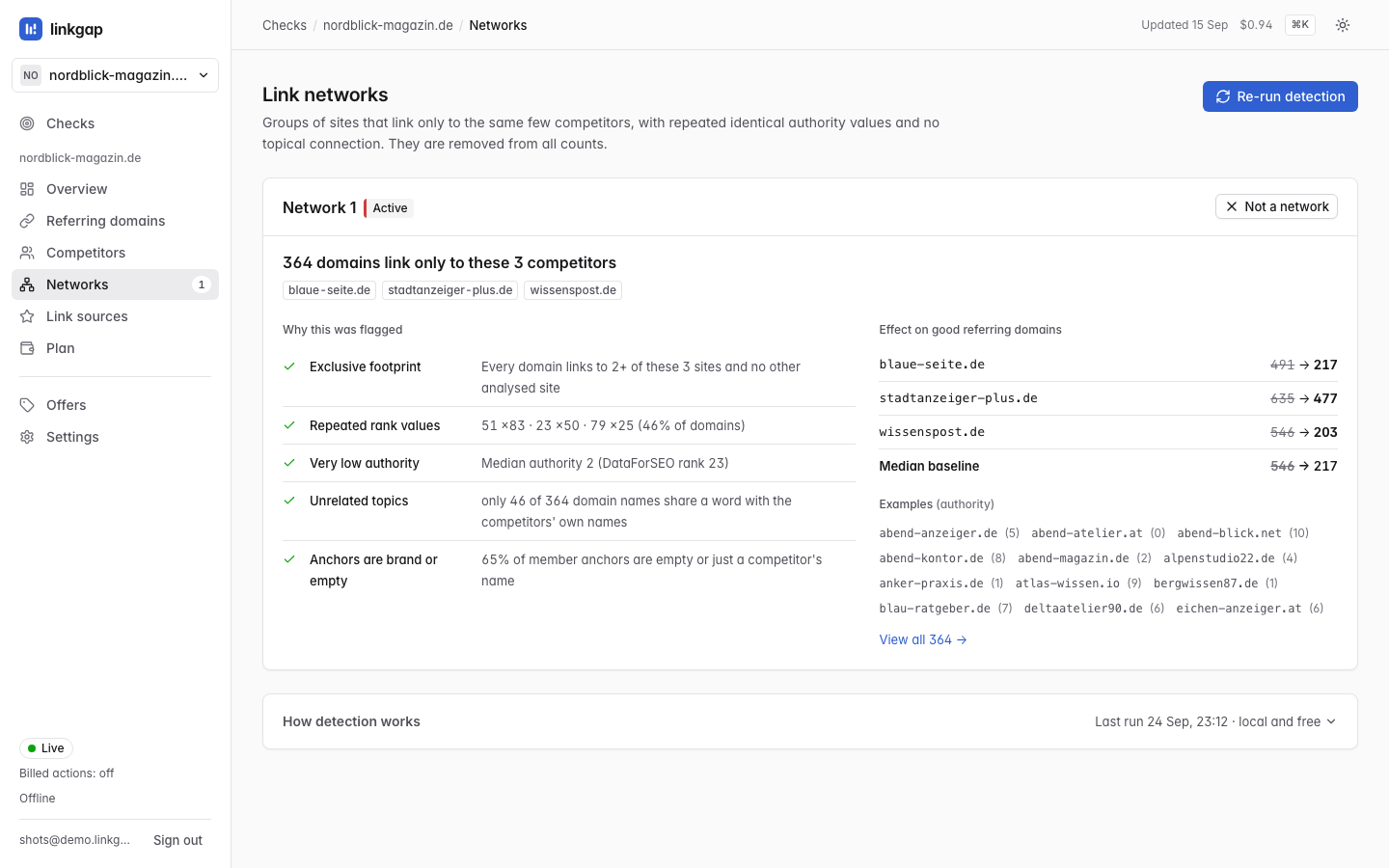
Short answer: you don't find a link network by looking at one domain at a time. You find it by looking at groups: many small sites that link to the same few competitors and to nobody else, sit on the same authority values again and again, have nothing to do with the topic, and carry empty or brand-only anchors. In the case below, 364 such domains were shared by three competitors. Taking them out shrank the gap to the middle competitor from 546 good referring domains to 217.
Everything here comes from one real, anonymised case: a new site with zero backlinks and seven competitors. Site names are invented; the numbers are real. You can do every check with a backlink export and a spreadsheet.
Why a network in someone else's profile is your problem
A competitor's bought network doesn't hurt you directly. It hurts your numbers:
- Your target gets inflated. If the benchmark competitor's count includes a few hundred bought domains, every gap, budget and proposal built on it is too big.
- Your shortlist gets polluted. Network members link to several competitors, so they rise to the top of every "links to them, not to you" report. They look like the best prospects and are the worst.
- You might buy into it. Members of networks are often for sale. A placement on one buys you a link that Google most likely ignores already.
Why checking domains one by one misses it
Each member of a network can pass a single-domain check: not on a blocklist, a modest spam score, some content on the page. Spam rules (very low authority, a high spam score, spam-typical domain endings) catch the worst of them. In the case, a sample of 1,000 referring domains from the leading competitor contained 294 spam domains, almost a third. The network was a separate finding, and it only appeared when all seven competitors' profiles were compared with each other.
The five signs, with the numbers from the case
1. An exclusive footprint
Every one of the 364 domains linked to at least two of the same three competitors, and to none of the other analysed sites. Real publications link to whoever is worth citing in their field, which usually includes more than three sites, and rarely the same three every time.
How to check: put every referring domain of every competitor into one table, one row per domain, one column per competitor, with a 1 where it links. Add a column that counts the 1s. Filter for domains that link to two or more competitors, then sort by the combination of competitors. A large block of domains with exactly the same combination, and nothing else, is your candidate group.
2. Repeated authority values
Inside the group, 46% of the domains sat on an authority value that eight or more domains shared exactly. The three largest clusters: 83 domains at authority 51, 50 at 23 and 25 at 79. Independent sites spread out across the scale. Many domains landing on exactly the same mid-range value points to sites that were built and boosted the same way, at the same time.
How to check: within the candidate group, count how many domains have each authority value (a pivot table does it). Ignore the very lowest values, which are common everywhere. A handful of values with dozens of domains each is the signal.
3. Very low authority
The median authority of the 364 members was 2 out of 100. On its own that only means "small sites". Together with the footprint it means many small sites working for the same few customers.
4. Unrelated topics
Only 46 of the 364 domain names shared even one word with the competitors' own names. When almost none of the sites linking to a group of competitors have anything in common with them, the links were not given for their content.
How to check: take the words from your competitors' domain names, and check which group members contain any of them. It is a rough test, so read it as a ratio, not row by row.
5. Empty or brand-only anchors
65% of the links from the group had no anchor text at all, or just the name of the site they pointed to. Packages are often placed that way, because neutral anchors attract less attention than keyword anchors.
Weighing the signs
No single sign proves anything. Plenty of honest small sites have low authority and brand anchors. What matters is the combination: a large group with the same exclusive footprint, clustered authority values, unrelated topics and neutral anchors. That is the pattern of a link package that was bought, or injected by someone else.
It is still a pattern, not proof. There are legitimate groups that can look similar: a real publisher's network of regional titles, a company's own sites, an industry directory family. If you know a flagged group is one of those, put it back in.
Some common footprints are not covered by these five checks: shared hosting or IP ranges, the same owner details, identical page templates or duplicated text. Those take manual work per domain. They are worth a look for any member you were about to buy a placement from.
What taking the network out changed
Three of the seven competitors had the group in their profiles. Their good referring domains before and after:
| Competitor (invented names) | Good referring domains before | After |
|---|---|---|
| wissenspost.de | 546 | 203 |
| blaufeder-journal.de | 491 | 217 |
| stadtanzeiger-plus.de | 635 | 477 |
The middle competitor went from 546 to 217. The new site had 0, so the gap fell by about 60%. Nearly two thirds of one competitor's profile was the network.
What to do once you've found one
- Leave it out of the gap. Measure against the competitor's profile without the group, and say in your proposal that you did.
- Take its members off your shortlist. Don't buy placements from them and don't pitch them.
- Check your own profile for the same pattern. If a group like this links to you, and you didn't build it, Google's advice is that most sites don't need to act. A disavow file is meant for many spammy or artificial links that caused a manual action, or likely will.
- Don't copy it. Google's spam policies name buying links for ranking purposes as link spam, and a network is about the most visible way to do it.
A checklist you can reuse
- Referring domains of five to seven competitors in one table.
- Domains that link to two or more competitors, grouped by which ones.
- For each large group: authority values counted, clusters noted.
- Median authority of the group.
- Share of member names related to the competitors' topic.
- Share of empty or brand-only anchors.
- Group removed from the gap, members removed from the shortlist, decision written down.
All figures come from one anonymised real case in September 2026. Placement prices are real marketplace offers; site names are invented.