What does link building cost? A worked example with real prices
Short answer: in our worked case the median price of a placement was €118. A €1,500 budget bought eleven links for €1,388.58. Matching the link strength of the middle competitor in full would have taken about 80 links for about €10,500. The bigger lesson isn't in the price per link, though. It's in how many links you need at all, and that number was far smaller than the backlink tool first suggested.
Every figure here comes from one anonymised case: a new site with no backlinks, seven competitors, 18 real offers from one link marketplace. It is not a market average. It is a calculation you can rebuild for your own project.
Why "price per link" is the wrong question
Search for backlink prices and you'll find ranges from a few euros to four figures. Both ends are true, and neither helps. A budget needs three answers:
- How big is your gap, really? How many more good referring domains do your competitors have than you?
- How many links does it take to close it? Not the same number, because links differ in strength.
- What do links of the quality you'd buy cost? This is where real offers come in.
Price per link is only the third answer. The first two move the budget far more.
Step 1: Count the gap properly
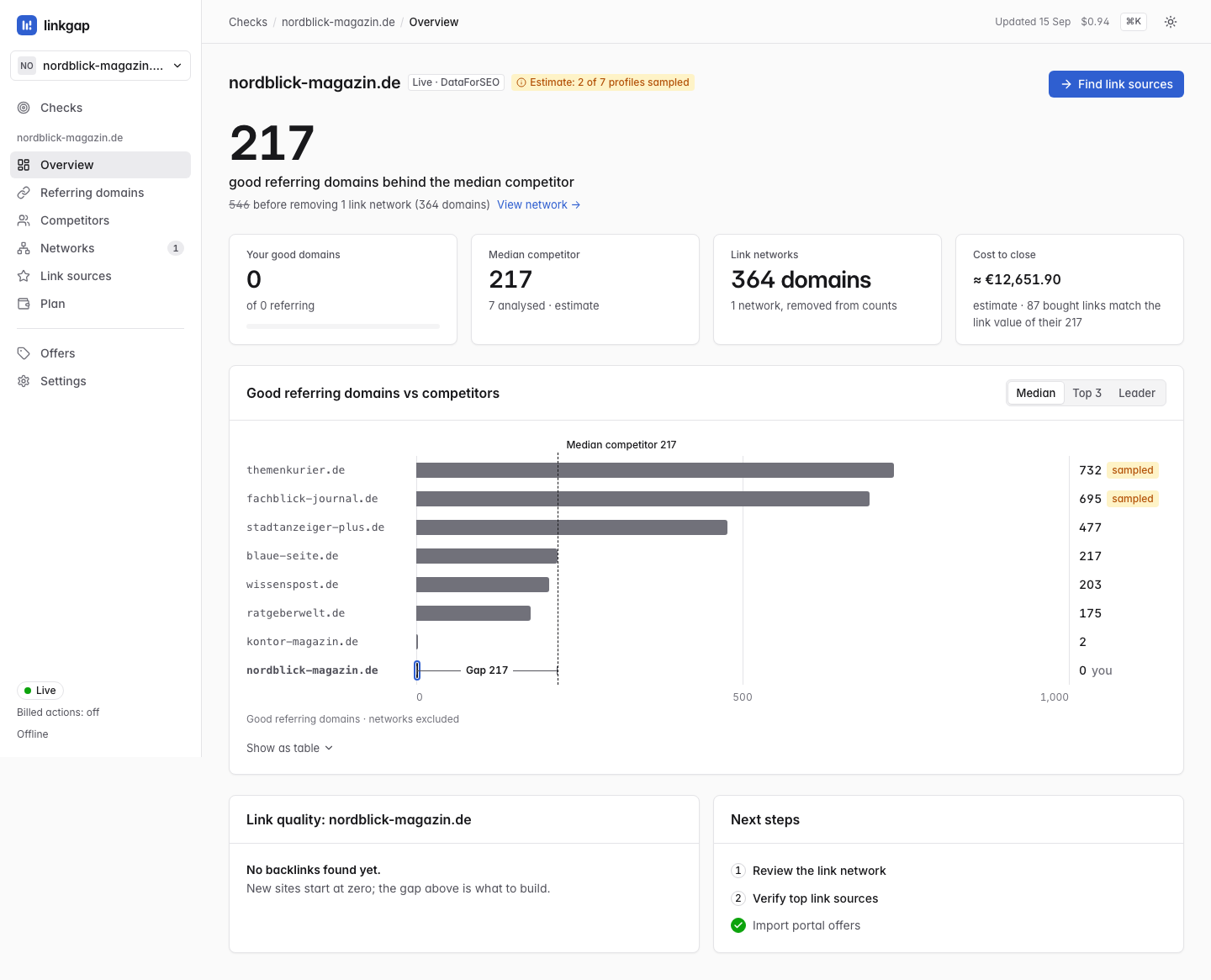
In the case, the middle of seven competitors had 546 referring domains that passed as good by the usual criteria. The new site had none. A gap of 546, then?
No. 364 of those domains belonged to one group that linked to the same three competitors and to no other site in the analysis. Their median authority was 2 out of 100. Only 46 of the 364 names shared even a word with the competitors' names. 65% of the links had no anchor text or just the target's name. And the same authority values came up again and again.
That is the pattern of a link network, a package that was bought or injected. It isn't proof, but Google most likely ignores links like these. (How to find such a group by hand: How to spot a link network in a competitor's backlinks.) Take the group out and the three affected competitors look like this:
| Competitor (invented names) | Good domains before | After |
|---|---|---|
| wissenspost.de | 546 | 203 |
| blaufeder-journal.de | 491 | 217 |
| stadtanzeiger-plus.de | 635 | 477 |
The middle competitor now has 217 good referring domains. The gap is about 60% smaller than it first looked.
Spam comes on top. The leading competitor had 25,216 referring domains; a sample of 1,000 was fetched, and 294 of them were spam, almost a third. The most common reasons: very low authority, a high spam score, a spam-typical domain ending.
The takeaway: before you talk about prices, check the number you're up against. A proposal built on 546 instead of 217 plans for more than twice the work.
Step 2: Weigh links instead of counting them
A gap of 217 domains doesn't mean you have to buy 217 links.
The domains behind that number are mostly weak: their median authority is 1 out of 100. The placements you can get on a marketplace are stronger. In our case the matching offers averaged DR 49.7.
Weigh links by authority instead of just counting them, and one such offer is worth about 2.7 of the weak domains in the model. So 217 becomes about 80 links to match the middle competitor's link strength.
Two caveats belong here. First, the calculation compares two different scores: the DR marketplaces advertise and the authority from the backlink data. They are related, not the same, so the factor 2.7 is indicative. Second, link strength is a model value. It says nothing about where you'll rank afterwards.
Step 3: Real offers instead of guessed prices
The calculation used 18 real offers from one marketplace. 15 remained. Three were dropped because they were below the quality floor of DR 20, or because their DR was doubtful: backed neither by the site's traffic nor by its price.
That filter matters more than it sounds. A high DR can be manufactured. If a site advertises DR 60 but has hardly any visitors and the placement is suspiciously cheap, you're paying for a number, not for a link that does anything.
Watch two more items on every offer:
- Surcharges for sensitive topics. Some publishers charge more for certain industries.
- Writing fees. If the publisher writes the article, that costs extra.
Both belong in their own columns. Otherwise you compare prices that aren't comparable.
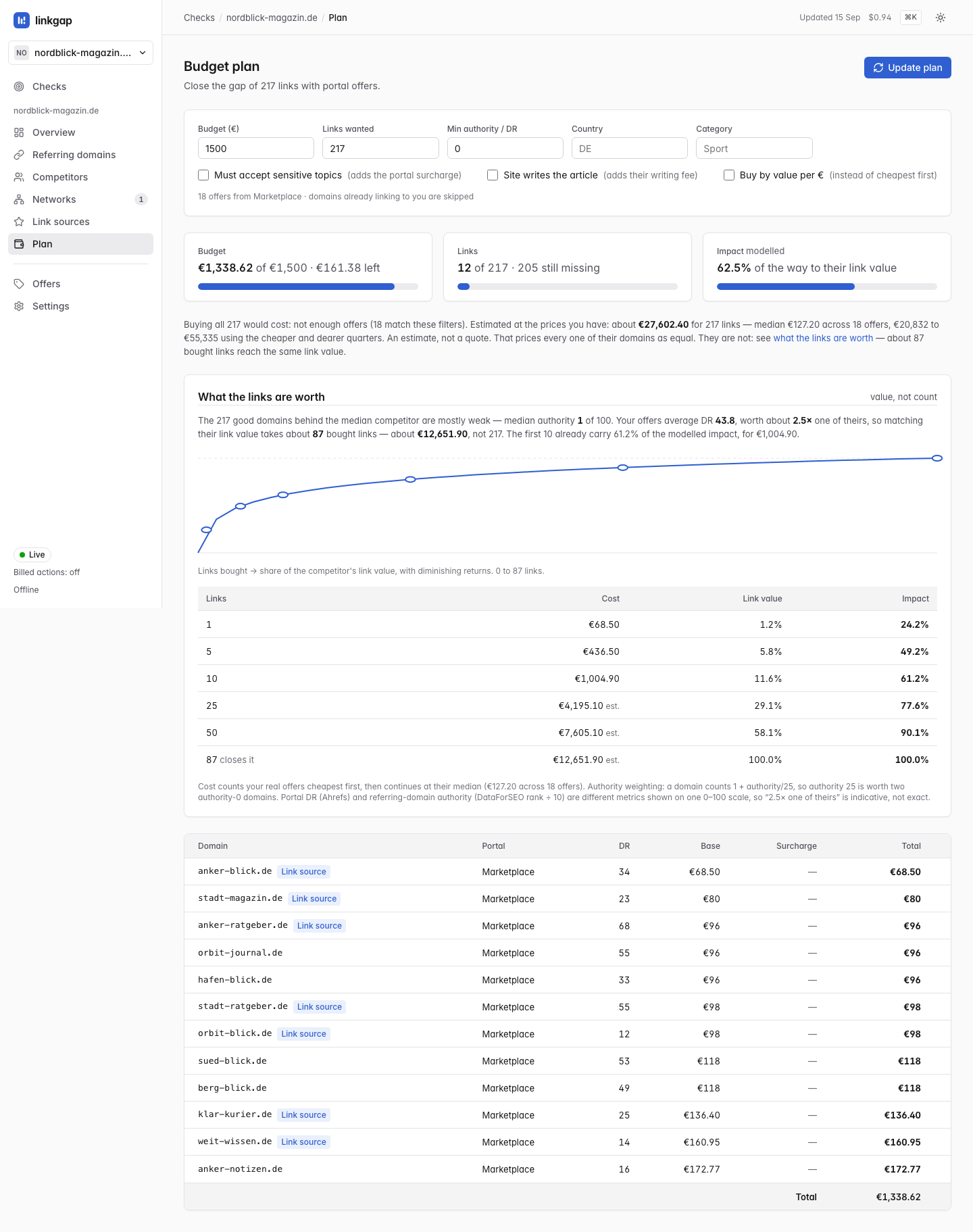
In this calculation the roughly 80 links cost about €10,500: the available offers are planned cheapest first, the rest at the offers' median price of €118.
Step 4: What the first budget buys
Few new sites have €10,500 for links. The more useful question is: what do the first €1,500 buy?
- A €1,500 budget buys 11 links for €1,388.58, with €111.42 left.
- The model puts that at 63.6% of the way to the middle competitor's link strength.
- The first ten links carry 63% of the estimated effect and cost about €1,100.
The reason is diminishing returns. For a site with no backlinks, each of the first links counts for a lot, and each one after that a little less. In this model, about a tenth of the full amount covers the larger part of the distance.
For budgeting, that is the most useful statement: start with a small, well-chosen package, measure what happens, and decide on the next one after that. To run the same kind of estimate on your own numbers, use the link budget calculator.
What the calculation doesn't say
- It isn't a ranking forecast. The model describes how close you get to a competitor's link strength. Whether and when rankings move depends on content, technical health and much more.
- It rests on one case. In your niche, prices and networks may look very different.
- It uses one marketplace's prices. Other portals, direct deals with publishers or agency packages price differently.
- It doesn't say you should buy links. Google's
spam policies
name buying links for ranking purposes as link spam. The calculation shows what the gap means in
money. Google also expects paid links to carry
rel="sponsored"; unmarked paid links are bought at your own risk. Whether you close the gap with paid placements, outreach or content that earns links by itself is your decision.
How to rebuild it for your project
A backlink export and a spreadsheet will do. Allow a few hours.
- Pick competitors. Five to seven sites that rank for your most important searches. Not the biggest brands, but the ones you actually meet in the results.
- Export referring domains for yourself and every competitor. Count domains, not single links.
- Clean up. Drop domains with very low authority, a high spam score or a spam-typical ending. Then look for groups: domains that link only to the same two or three competitors, are off topic and share suspiciously identical values.
- Use the middle competitor, not the leader. One giant doesn't skew the median.
- Collect offers in the quality you'd buy. For each, check that the DR fits the traffic and the price. Note surcharges and writing fees separately.
- Weigh. Compare the strength of the offers with the strength of the domains behind the gap, and work out how many placements give the same link strength.
- Report two numbers: what your first budget buys, and what closing the gap in full would cost.
Common questions
What does a single backlink cost?
In our case the median offer price was €118, with a quality floor of DR 20. That is the value from 18 offers on one marketplace, not an average for every industry.
How many backlinks do I need?
Fewer than the raw count in your backlink tool suggests. In the example, 546 domains became 217 (without the network) and then about 80 links (weighted by strength).
Are ten links enough?
For a new site, the first ten links carry 63% of the estimated effect in the model. Whether that is enough for the rankings you want is something no model can promise.
Are bought links risky?
Google treats them as link spam when they are meant to influence rankings. That is exactly why it pays to check which of your competitors' links probably don't count at all, before you chase a number.
All figures come from one anonymised real case in September 2026. Placement prices are real marketplace offers; site names are invented.